
Student Spotlight
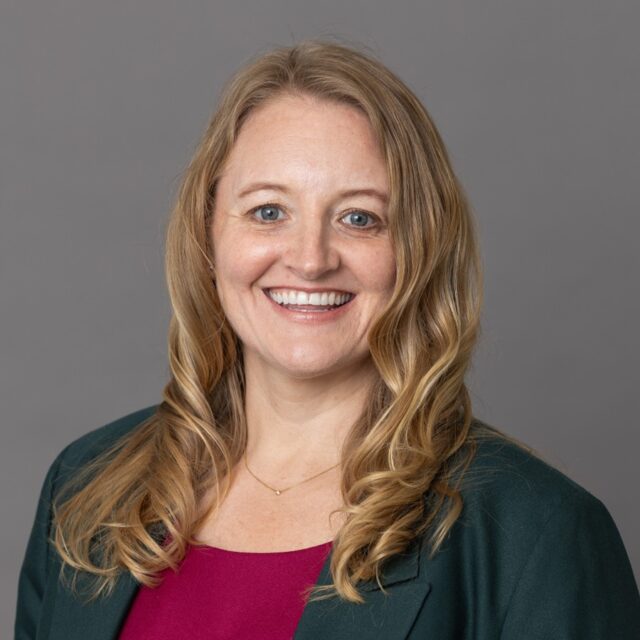
Trisha Bielski
Senior Consultant , Health Management Associates
Residence: Connecticut, USA Nationality: USA
Class of 2026
Currently a senior consultant with HMA, based in the Austin, Texas, area, Trisha Bielski earned a BS in Registered Nursing at University of Wisconsin-Oshkosh as an Army ROTC member. After college, she began an intense career as a military nurse at various Army hospitals, including as a Critical Care Clinical Nurse Specialist at Walter Reed National Military Medical Center and as a flight nurse on the battlefield in Afghanistan. Along the way, she earned a master’s degree in clinical nursing at San Diego State University. Bielski recently spoke about how the NYU MSHLS program is valuable for her as a consultant in the industry.
Q: What motivated you to pursue a career in healthcare?
I was introduced to healthcare at a young age because my mom is an ICU nurse. Hospitals and stories about patient care were a normal part of life, so I always assumed I would end up in healthcare in some way.
For a long time, I planned to go into dentistry, but when I looked more seriously at the schooling, I chose nursing since it was fewer years of training.
During nursing school, I joined Army ROTC to help pay for school. I was commissioned in March 2001 as an Army Nurse Corps officer and retired after 20 years of active service. During my service, I deployed twice as a critical care trauma flight nurse to Iraq and Afghanistan. Those experiences confirmed that healthcare was the right fit for me and shaped how I think about patients, teams, and systems of care.
Q: Who are your clients at HMA, and what are you most often advising them about?
Most of my clients are on the delivery side of healthcare: health systems, hospitals, private practices, and behavioral health organizations, with some work for government or quasi-governmental entities. They are all trying to navigate complex regulations and payment models while still delivering safe, effective care.
My work spans quality and patient safety, accreditation and regulatory compliance, financial and revenue cycle issues, and clinical operations. A big part of my role is interpretation and translation. I help clients understand what a new rule or policy actually means for their organization and then turn that into clear expectations, processes, and structures that their teams can realistically follow.
Q: What concerns your clients most about the U.S. healthcare environment?
Their biggest concern is constant change. Policies shift with each administration, payment models and incentives evolve, and accreditation and reporting requirements keep expanding, while they are managing workforce shortages, financial pressures, and daily operations.
Most of my clients are willing to be held accountable; they simply do not want to get it wrong. They worry about missing a key requirement, jeopardizing reimbursement, or being flagged for potential fraud, waste, or abuse. At the same time, they are trying to protect their staff from burnout and their patients from harm. Balancing regulatory expectations, financial stability, and patient care in an environment that never really stands still is what weighs on them most.
Q: What are your career goals and how can the MSHLS program help you achieve them?
I have always been drawn to the legal side of healthcare, but I did not necessarily want to pursue a traditional JD. Early in my career, I was involved in a medical malpractice case and saw firsthand how the system handles patient harm and provider responsibility. It made me think about whose interests are centered when something goes wrong. If you choose to work in that space, you have to decide where you stand. Even though I care deeply about my fellow nurses and providers, I believe patients are the most vulnerable and need the strongest support.
Over time, my focus has shifted toward compliance and toward fraud, waste, and abuse. I am interested in how organizations design systems that prevent problems and respond effectively when issues arise. The MSHLS program gives me the bridge I need: a strong grounding in health law, regulation, and policy without becoming an attorney. It helps me build the tools and perspective to move more deeply into oversight, investigation, and adjudication roles. After graduation, I plan to layer on additional certifications to support that path.
Q: For consultants like you, what are the strengths of the MSHLS program? What benefits do you expect to get from it, and why?
In my consulting work, I operate mostly at the organizational level, inside hospitals and clinics, solving specific operational and strategic problems. The MSHLS program gives me a higher-level view. It helps me see how laws and regulations are created, who is at the table, and how economics, ethics, and politics shape the final product that becomes a statute, rule, or CMS policy.
That broader context makes me more effective with clients. It lets me explain not only what a requirement is, but why it exists and what goals it is trying to achieve. From there, we can design responses that are both compliant and aligned with their mission and patients.
A major strength of the program is its interdisciplinary design. Law, policy, economics, strategy, and ethics are woven together in a way that reflects how healthcare really functions. For someone in consulting, that integrated way of thinking is very useful. I can bring it into work on accreditation readiness, quality improvement, payment reform, and beyond. Ultimately, I expect the program to make me a better connector between policymakers and the organizations that have to implement policy on the ground.